
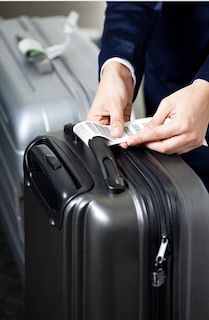
A pre-serialised tag, a scan by the guest, and an item is allocated — outside your data environment, with nothing on the bag that identifies anybody.
That is the whole invention, and it is what the patent claims. A pool of identifier codes is generated in advance and printed as variable codes onto sealed, regulated stock. Nothing is attached to anybody. The binding to a person happens later, at the scan, on their device — which is why nothing has to happen on yours.
Inactive. Not yet attached to a person, an item, a destination or a campaign.
Sealed rolls or fanfold — the same controlled stock that already carries boarding passes and IATA baggage tags. The seal is the anti-fraud control.
No login. No lookup. No integration. No network. This is the step every other approach cannot do, and the step that has to work at an aircraft door.
The guest supplies their own details, on their own device, in their own time. No identity verification is required at activation.
The destination behind an already-printed code lives in the cloud, not on the paper. Outcomes are switched in real time.
Which is why a label printed in January can run a campaign finalised in June. An ordinary QR code sends everyone to the same page, forever, because the destination was fixed when the ink dried.
Airlines mishandled 25.4 million bags in 2019 — a rate of 5.6 per thousand passengers, at a cost of more than $2.5 billion (SITA Baggage IT Insights). Hotels have the same problem in the lobby, one suitcase at a time. In both cases the question at the counter is not where is it. It is whose is it, and can they prove it.
The digital half only matters if the physical half survives an operation. This one was designed for the aircraft door first.
Rights are territorial. This is what is held, where, and what is still pending — the full register, with filing and registration dates, is published.
The same token works on anything printed in bulk where an operator needs a one-to-one digital outcome without touching their own systems.
A customer attaches ownership to a new television without keeping the till slip — and if it is gifted, the new ownership token feeds back into the retailer’s own data.
A promotion runs on a specific product line, updated in real time across labels already in the field, onboarding and offloading partners at will.
Twenty million passengers a year receive one in South Africa, and it becomes waste at the gate. One scan can make it a national tourism discovery platform — no integration, no passenger data, POPIA-clean.
We will come back with what we would make, how it reaches every location you operate, and what happens after it is in their hand. Every enquiry is answered within one business day.